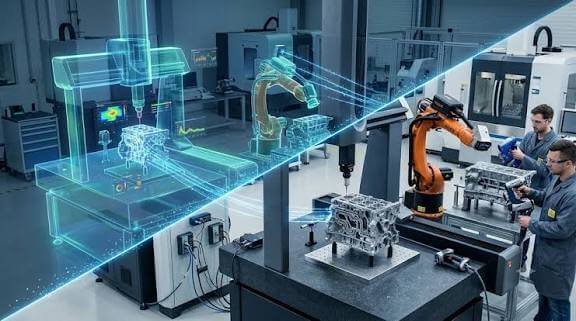
Digital twins create precise virtual copies of assets and processes, mirroring real-time signals to enable risk-free simulations and proactive reliability management. They translate streams of data into actionable workflows, reducing unplanned outages and extending asset life. Real-time governance and adaptive models sustain continuous improvement, while cross-domain collaboration scales analytics to strategic goals. The result is higher uptime and efficiency; the path forward hinges on integrating these models into core decision loops—a challenge few can overlook as technology evolves.
What Digital Twins Are in Industrial Operations
Digital twin basics illuminate asset behavior, while industrial simulation experiments scenarios without risk.
Decision-makers gauge performance, optimize processes, and forecast failures.
This vision supports freedom-driven strategies, structured by analytics, interoperability, and scalable, data-centered governance across complex systems.
How They Drive Reliability and Uptime
Digital twins translate asset performance data and real-time signals into a high-fidelity virtual replica, enabling proactive reliability management and sustained uptime.
They translate insights into actionable workflows that minimize unplanned outages, optimize maintenance windows, and extend asset life.
Predictive maintenance becomes anticipatory, while operator training accelerates response, ensuring crews act decisively.
This clarity fuels strategic investments and freedom to innovate.
From Data to Decisions: The Tech Behind the Twins
From the reliability focus, the conversation shifts to how data is transformed into decisive action within digital twins. Data governance structures enable clean, trustworthy inputs, while real-time streams feed adaptive models. Predictive maintenance emerges as a proactive discipline, prioritizing uptime over intrusion. The tech ecosystem aggregates signals, validates insights, and translates them into autonomous, strategic decisions that elevate operational freedom and performance.
Real-World Gains Across Sectors and Use Cases
Across sectors, digital twin deployments are translating predictive insights into tangible performance gains, from manufacturing throughput to energy efficiency and asset resilience. These implementations demonstrate clear cost benefit by aligning operational metrics with strategic goals, enabling rapid ROI and reduced risk.
Stakeholder alignment emerges as a core capability, guiding cross-domain collaboration and accelerating informed decisions that unlock scalable, resilient value across discrete use cases.
Frequently Asked Questions
How Do Digital Twins Handle Data Privacy and Security Risks?
Digital twins mitigate data privacy and security risks via encryption, access governance, anomaly detection, and provenance tracing, enabling resilient, auditable environments; they empower strategic freedom by balancing openness with rigorous controls, threat modeling, and continuous vulnerability assessments.
Can Digital Twins Predict Maintenance Without Historical Failure Data?
A brave new frontier rises: digital twins can enable predictive maintenance even without historical data requirements, leveraging simulations and real-time signals. They envision proactive strategies, data-driven decisions, and freedom through anticipatory, risk-aware asset optimization and resilience.
What Are the Upfront Costs and ROI Timelines for Startups?
Upfront costs vary with scope, software, and integration, but startups can expect initial investments in platforms, sensors, and data pipelines. ROI timelines align with efficiency gains and predictive insights, typically 12–24 months, empowering strategic, freedom-focused growth and scalable profitability.
How Do Twins Integrate With Existing Legacy Industrial Systems?
Integration with legacy systems faces integration challenges, yet twins leverage legacy adapters to bridge protocols, data models, and security gaps, enabling scalable interoperability; a data-driven, strategic vision empowers operators seeking freedom through accelerated modernization and resilient, future-ready operations.
See also: The Future of Cybersecurity Technology
What Standards Exist for Interoperability and Data Governance?
Standards interoperability and data governance exist to harmonize data exchange, enforce trust, and accelerate collaboration; visionary operators leverage common protocols, open schemas, and governance frameworks to unlock scalable, autonomous decision-making across heterogeneous industrial ecosystems.
Conclusion
Digital twins fuse real-time signals with intelligent modeling, turning data into predictive insight and actionable workflows. They enable proactive reliability, optimized throughput, and sustained asset health across complex industrial ecosystems. By simulating scenarios at scale, organizations reduce risk, accelerate decision cycles, and unlock continuous improvement. As governance and adaptive models mature, the path from data to decisive action becomes clearer. How will your operations leverage twins to transform downtime into uptime and ROI into resilient performance?
